
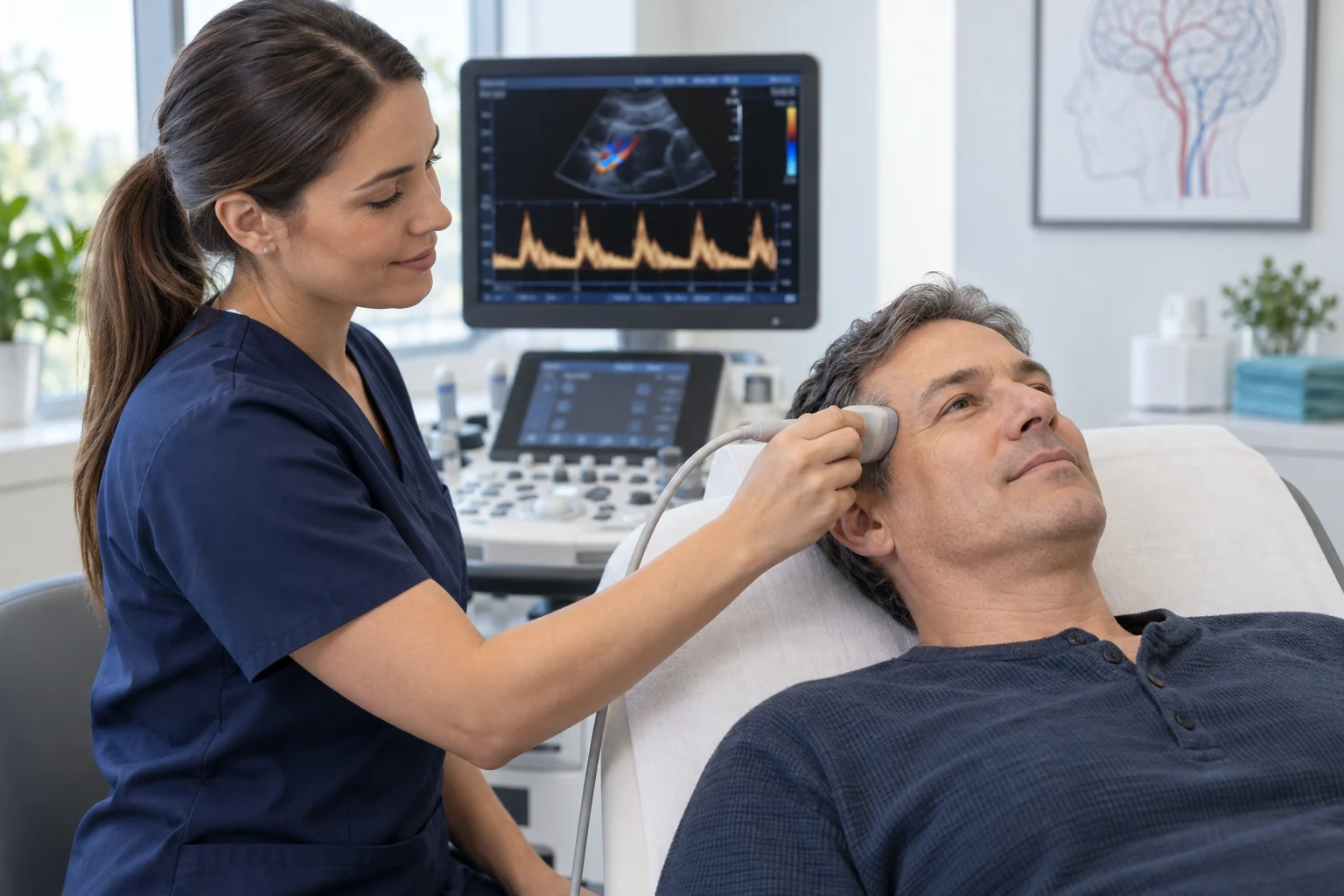
How does this test work?
The probe sends sound waves through suitable areas of the skull and records echoes from moving blood cells. The recordings describe blood-flow speed and direction. A trained physician uses this information when evaluating circulation within the brain.
When might this test be considered?
Your clinician decides whether the test is appropriate for your symptoms and medical history.
- Evaluation of narrowed brain arteries
- Monitoring blood-flow changes after stroke or TIA
- Assessing vasospasm or sickle cell-related stroke risk when indicated
What happens during the test?
- You sit or lie comfortably while gel is applied to selected areas of your head or neck.
- A technologist moves a small probe over the skin and may ask you to keep still.
- You may hear a whooshing sound or feel light pressure; test duration varies.
How should I prepare?
A standard TCD usually needs no special preparation. Follow your appointment instructions, including any advice about contact lenses; specialized studies may require separate instructions.
How are results interpreted?
A physician reviews the recordings and sends a report to your ordering provider, who explains the findings and whether follow-up is needed.
What are the limitations?
TCD answers blood-flow questions; it does not replace every other brain investigation. Follow-up testing may be needed to obtain additional information or monitor a condition.
Comfort and safety
Standard TCD is noninvasive and does not use ionizing radiation. You may notice cool gel and light pressure. Keeping your head still helps the technologist collect the recordings.
Common questions about TCD
How long does a TCD usually take?
Cleveland Clinic describes a typical study as about 30–60 minutes. Your ordered study and appointment may differ; confirm the schedule with the team.
Is a bubble study included?
Some specialized studies use an IV and saline. That is different from a standard external examination. Confirm exactly what was ordered and whether it is available.
Questions to ask before booking
- Is the exact test on my clinician's order available?
- Where will the appointment take place, and what should I bring?
- Are there specific preparation or referral instructions?
- What fees apply, and what should I check with my insurance provider?
- Who will explain my results, and how should I arrange follow-up?
Confirm these details with VitaSense before booking. Availability, coverage and results timing are not established by this general test guide.
Patient information source
For more information about the test, see Cleveland Clinic transcranial Doppler information.